
Since we published Training for the New Alpinism, one question has come up more than any other: how do I balance work, family, and the rest of life with the desire to be fit for the mountains? The specifics vary—some people are constrained by location, some by energy, some by time—but the pattern is consistent. Most of these athletes are cramming a week’s worth of activity into one or two days, then wondering why they aren’t improving.
There is nothing wrong with being a weekend warrior. For many people, getting out on Saturday and Sunday is what keeps them sane. But if you want to bring your fittest, healthiest self to those weekend adventures—and see meaningful progress over months and years—the boom-and-bust cycle of weekend-only activity will hold you back. Understanding why requires a short detour into how your body actually responds to stress.
How Does Your Body Adapt to Training?
Your body maintains a state of internal balance that physiologists call homeostasis—a carefully regulated equilibrium of hormones, enzymes, heart rate, temperature, and other physiological variables. Any stress you apply to the body, whether a hard run or a cold virus, temporarily disrupts that equilibrium. The body then spends energy restoring balance. This is why you feel tired, stiff, or sore after a hard effort: your systems are working to return to baseline.
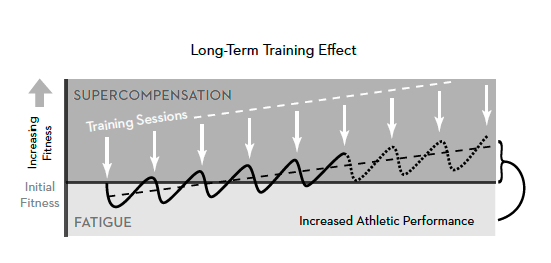
Hans Selye, the founder of stress research, was the first to study this process systematically. He found that when stress is applied in the right dose and frequency, the body doesn’t just return to its previous state—it adapts. It builds back to a slightly more robust baseline, better equipped to handle that type of stress the next time it encounters it. This is the training effect, and it is the foundation of all modern sports training theory.
The key insight from Selye’s work is the distinction between two types of stress:
Chronic stress (the good kind): Frequent, moderate, progressive training stimuli that allow the body to adapt incrementally. Each session pushes homeostasis slightly, and the body builds back a little stronger each time. This is how fitness is built.Acute stress (the counterproductive kind): Infrequent, large, excessive efforts that overwhelm the body’s capacity to adapt. Homeostasis is disrupted too much and too seldom for the body to build anything meaningful from the experience. Over time, this pattern produces fatigue and stagnation, not fitness.
Why Does Weekend-Only Activity Fall Short?
The weekend warrior pattern is a textbook example of acute stress. You spend the week at a desk, then go out on Saturday and subject your body to a large training load it hasn’t been prepared for. The effort is significant enough to cause real disruption to homeostasis, but it happens so infrequently that the body never gets the repeated stimulus it needs to adapt. You recover during the week, return to baseline (or close to it), then do the same thing the following weekend.
The result is a cycle that feels productive—you’re tired, so it must be working—but doesn’t produce long-term gains. Worse, the repeated pattern of large, infrequent stress without adequate preparation increases the risk of injury and makes each outing harder than it needs to be. You arrive at the trailhead or the base of the climb already behind, carrying the accumulated fatigue of an approach your body wasn’t conditioned for.
What Should You Do Instead?
The shift from weekend warrior to structured athlete doesn’t require dramatic changes. It requires consistency. Even modest midweek training sessions—a 45-minute run before work, a lunchtime strength session, an easy evening hike—transform the pattern from acute stress to chronic stress. Your body begins receiving the frequent, moderate stimulus it needs to actually adapt.
The training doesn’t have to be long or intense during the week. In fact, for most mountain athletes, the weekday sessions should be easier than the weekend efforts. The goal is to maintain the conversation between training stimulus and adaptation, rather than letting five days of inactivity erase whatever signal the weekend provided.
There is also a psychological benefit worth noting. Research consistently connects regular exercise to improved stress management, mood, and mental clarity. Going for a run before or after a hard day at the office may not sound appealing, but it is one of the most effective things you can do to manage the accumulated stress of the workweek. The weekday sessions serve your body and your mind, making the weekend adventures more enjoyable when they arrive.
How Do You Get Started?
If you recognize yourself in the weekend warrior pattern, the path forward is straightforward. Start by adding two to three easy sessions during the week. These don’t need to be heroic. A 30- to 60-minute low-intensity effort is enough to shift the adaptation signal from acute to chronic. Keep the weekend for your bigger mountain days, but let the weekday sessions build the base that makes those days more productive and more enjoyable.
The harder part is knowing whether what you’re doing is actually working. That uncertainty—am I improving, or am I just tired every Monday?—is what keeps many weekend warriors stuck. You need structure, and you need visibility into your own progress.
This is why we built Training Groups. They provide coach-guided programming designed for athletes with full lives and limited time—the kind of consistent, progressive structure that turns random midweek sessions into a real training program. Your training data flows into an athlete dashboard that tracks the metrics that matter: whether you’re showing up consistently, whether your aerobic fitness is progressing, and whether you’re balancing training load and recovery. You can see the answer to the question you’ve been guessing at.
Training Groups sit between self-directed training plans and 1:1 coaching. They offer the structure and accountability that weekend warriors need most, without requiring the commitment or cost of a fully individualized coaching relationship. If you’re ready to move beyond the boom-and-bust cycle and start building fitness that compounds over time, this is the place to start.